I started volunteering in The Gambia in August 2010 with VSO and have now made my way to India - I'll be home for the Olympics.

Sunday, 29 January 2012

On the QT I'm now a UQT

Kankia Residential School - my "computer lab" is on the 2nd floor, 1st two windows from the left


Just before Christmas last year, I started "teaching" IT lessons to tribal (Adivasi) children at Gram Vikas' nearby Kankia Residential School. Back in The Gambia a UQT is an unqualified teacher - I guess this is a promotion from my previous role as IT trainer? I spend each afternoon at the school running through the basics of IT with year six and seven kids (ages 11-13 I guess) and then an hour training their teachers too. We have four PCs (which I'm planning to increase) and a printer, no Internet connection at the moment though. I get to school using my GV bicycle as it's only six kilometres away. The countryside is spectacular around Mohuda - I head through fields of padi, tomatoes, garlic and onion. After my trip back home to the UK for Christmas I've added a few new features to my bike - a horn (vital when alerting people and water buffalo) and also flashing lights so that trucks see me on the quiet country lane (it gets dark quite quickly 6pm). Whenever a truck or bus gets anywhere near I tend to quickly jump off the road as cyclists are the lowest of the low out here.

The students are up by 5am!


I made the school boy error of parking the bike outside our computer room during my second week, every passing student couldn't resist honking the horn! This only happened on the one day as I think my bike was made out-of-bounds by the headmistress the following day. Fellow cyclists have also commented on the horn (a couple have actually turned around in amazement). I see a business opportunity here, supplying cycle accessories to the one billion bicycles in India! It's great to get out of the office (although when it gets much hotter/wetter, maybe not so) and the exercise is great too. Currently my record for the return from school is 15 minutes 42 seconds - GPS tracked no less.

Spectacular scenery on my route to school


My lessons are going well, although keeping a track of how many lessons each student has had is tricky - so far I've had six girls glasses and only two for boys? As it's Saraswati Puja this week (and Republic Day last Thursday) I think the boys have been seconded to other duties. Saraswati by the way is the Hindu goddess of knowledge so schools in the area celebrate this with a big festival. In my "computer lab" I have a whiteboard to write on and I'm slowly mastering the art of writing in straight line, without it sloping off to the right. It's strange how spelling seems to dessert you at this time and that big full stops are very important. I do occasionally have an issue with the students understanding my English accent. They seem to understand what I write on the board OK; I've been advised to try teaching with an Indian accent but I just can't do it - I'd end up sounding like Peter Sellers in the film The Party - "Birdie num num!"

Look at that enthusiasm, who says IT is boring


Sunday, 18 December 2011

Toilet Building

Here's a copy of my masonry training report from Kaliabali. Apologies for the formal writing style but I think it'll give you a good idea of Gram Vikas construction work. I've never helped build a toilet before!

Kaliabali, a very colourful village


"Day 1: Building a Toilet.

We began our visit by viewing the construction of foundations at the lower end of the village, nearest to the busy State Highway 5. A mortar and stone-work layer had been placed on top of a dry stone base. Heavy rocks had been used to create a good solid structure. The height of the foundations is important - it is critical that they are above the height of any nearby land. In the event of flooding (monsoon season) this will minimise the risk of the toilet contents contaminating the land. We then moved to a clearing nearby to start our layout planning work. We were all given sketch maps of the standard Gram Vikas toilet and bathroom design, with all the necessary dimensions. We observed measurements being drawn to scale in the soil and marked out with ash powder. Strings attached to stakes were used to measure out the foundation dimensions of nine feet by five feet eight inches. Care was taken when staking the corners to ensure we had correct right angles – two stakes per corner were used instead of one. After lunch we (Abhishek, Anvesh, Rakesh, Rohit and I) attempted to recreate this. We experienced difficulties with the placement of stakes (twisted stakes, hard ground) and unclear marking of the string. This lead to the dimensions marked being approximately an inch out. To ensure we had the correct right angles we had used the Pythagorean triple measurement of three inches by four inches by five.

Ash powder marks our foundations


After lunch we moved to a different site and observed the next stage of construction after the foundations had been laid. A level layer of cement (locally referred to as masala) was placed on top of the foundations; bricks (which were wet so they didn't draw the moisture out of the mortar before curing) were then added as a plinth layer. The bricks were laid with stretcher side up giving the greatest degree of strength. A further level of stretcher bond brickwork was then added. Work finished for the day as the light was becoming poor and a lack of bricks had arisen.

Laying the bricks on a good base


Day 2: Time For The Porcelain.

On the following day we returned to the main building site. We would observe the fitting of the p-trap, porcelain bowl and the piping to the soak pits. The function of the p-trap is to provide a seal between the toilet and the soak pit. The trap (due to its u shape) will always contain a small amount of water, which will prevent bad odours from returning to the toilet building. The trap was tested first by filling it with water and then placing it on a level surface and ensuring the seal remained. The two soaks pits were dug within four feet of the toilet. The height again was important so that the contents of the pits wouldn’t contaminate the land in the case of a flood. Three four foot diameter concrete rings were used; the small gap between the rings and the empty pit at the bottom will allow the contents to decompose and soak away (hence the name soak pits). It was also important to ensure a gradual slope in the pipe so that the contents would disperse freely. Great care was taken forming the Y chamber from bricks and cement; again to ensure no blockages. If any problems arose a bar or stick could be inserted to clear any object fowling the pipe work. The Y chamber allowed the re-routing of waste once the original pit had become full. Once emptied the pit would be re-used.

Almost ready for the roof


Day 3: Putting The Roof On.

On the final day of our visit we observed the finishing touches added to the Y chamber and soak pits, the construction of a toilet roof and, after lunch, we conducted an interview with Tatayya and his family (the gentleman who initiated the Gram Vikas installation). Brickwork around the top of the concrete ring allowed the piping to become fully incorporated into the structure. A concrete lid would then be placed over the pit. A mesh frame had been created in a nearby field by fastening steel rods together using wire. This was then raised onto a bed a branches/leaves to act as a barrier to stop the concrete "drawing up" the brickwork below. Temporary supports were then put into place before the mixed concrete was poured onto the roof.

Construction of the Soak Pits

We then took the opportunity to interview Tatayya, the man whose family would be using the first toilet/bathroom constructed in this village project. They are among the most vulnerable people in the village; he is a migrant labourer earning ~150 rupees a day (£2), his wife works in Berhampur and earns 100 rupees after travelling expenses. They have two daughters, the younger of which had dropped out of school due to the high costs and now gets occasional work at a local cashew nut processing factory for 60 rupees a day. Their concern mainly lay with finding a secure location for toilet requirements. A large amount of the nearby land (close to the highway) has changed ownership recently with a view to development and so toilet trips (open defecation) had become increasingly difficult. Water access in the village wasn’t bad, it could be drawn from the village well - but the provision of a piped supply would considerably reduce the work of village women. Bathing currently occurs not far away; the busy state highway has to be negotiated first to gain access to the open pool. We observed a traffic accident within thirty minutes of our arrival, so not having this route to take would obviously benefit the villagers."

Tatayya interviewed by Anvesh and Abhishek


I should have popped this report into last year's blog but heading back to the UK for Christmas meant I forgot. Will update blog again very soon with my UQT exploits at Kankia School...

Monday, 5 December 2011

Cool Kalahandi

Beautiful Kalahandi - 3000ft up meant cool nights (great relief)


Khandual Waterfalls in Karlapat Wildlife Sanctuary


Another blog entry produced so quickly? An early Christmas present perhaps? It’s actually because I've been out in the field. With one days notice I packed my rucksack with a week's clothes, a sleeping bag, mosquito net and a warm blank; I was heading to Kalahandi. The overnight train left Berhampur at 22.25 and I was due to be picked up by field staff at Tikiri at 06:55 the following morning. Kalahandi is a remote district in eastern Orissa, known for its wildlife sanctuaries and hillside villages. To give you some idea of the size of India (and Orissa) Kalahandi has a similar population as The Gambia (1.5m) and occupies about 80% of the land. There are thirty other districts in Orissa and thirty five states/unions in India! Anyway back to the field trip - I'd brought a good blanket as we'd be staying at 3,000ft in the field office - warm days but chilly nights. I'd be joined by Rohit, his wife Anusha and her brother Abhishek - three new Gram Vikas managers. Our plan would be to visit a number of villages that had implemented various GV projects - ranging from standard gravity-flow bathroom/toilets to micro-hydro plants and solar powered installations. The current record low price for solar panels has lead Gram Vikas to plan numerous installations at their own field offices and schools - we would be carrying out pre-install surveys at Bafala and Thuamal Rampur School. We were picked up in a Mahindra Bolero jeep - squeezing nine of us and baggage into the vehicle for the three hour journey. Some of the roads were little more than tracks; at one point we had to leave our vehicle and trek for hour, crossing a river by boat, before visiting an impressive solar powered site at Maligaon. Gram Vikas' role is one of facilitator, with a small funding role. The majority of the funds for projects are sourced from government schemes and the villagers themselves (usually including labour and materials too). We're always very warmly welcomed - many villagers think we're actually benefactors and I've even had children touch my feet (a Hindi sign of respect) - very humbling.

Solar installation at Malagaon


The following day we visited a local school, only a few yards from our programme office. Solar panels would soon be fitted to the school's roof allowing both the school and office to share electricity 24/7. The life of a solar panel is typically about twenty years with minimal maintenance - batteries last considerably less (~five years) with continued distilled water top-ups. Gram Vikas also makes the effort to integrate its schools/offices with the local environment. You'll notice numerous crops being grown, water from wash-rooms/toilets recycled to grow papaya/bananas. Even the playground was constructed using local wood swings and roundabouts. They’ll be pretty much self sufficient.

Thuamal Rampur Gram Vikas School - one of four residential schools in Orissa


The food at the field office was another highlight (again benefiting from the school crops). The rumour is that it is deliberately so - an incentive for people to leave the comfort of the head office in Mohuda and brave life in the field. We had wonderful vegetable curries, salads and amazing ginger chai (tea). Another hardship (not really for me) is the lack of mobile/cellular coverage. It's understandable that people will want to keep in touch with their loved ones when posted to remote areas. Kalahandians have an amusing solution to this - they're called "Hello Points". These are areas (usually on the top of a mountain or a cliff edge) of weak cellular coverage - people gather to make/receive phone calls. In one case three guys were actually surfing the Internet with a laptop on a cliff edge (I mentioned my blog but they weren't interested).

Hello Point - Extreme Internet surfing!


The following day we would visit a micro-hydro plant - something I was looking forward to. Kalahandi as you'll have gathered is quite hilly and water is utilised to the maximum by Gram Vikas. Standard sanitation/bathroom installations make use of gravity flow water supplies; that is taking water from a higher source allowing it to then work in showers, bathrooms, flow uphill etc (using the siphon principle). Hydraulic rams are also used to aid the movement of water to outlying fields - they require no additional power other than a water supply, all very clever. Where there is sufficient water flow small hydro-electric turbines have been installed to generate power for an entire village (up to 15kw in the case of Purnaguma). The villages where GV have carried out projects are not only transformed by improved health with clean water supplies but they also become oases of fruit, vegetables and flowers.

15Kw Micro-hydro at Karnivel


Gram Vikas ensures clean drinking water!


Two volunteers at Gram Vikas would be moving on in November - Jack continued on his gap year travels by visiting Thailand. He then heads to Laos/Vietnam/Malaysia/Singapore before flying to Argentina (back via the Middle East?!?), then to California before finishing off in Australia – the route looks crazy on a map. Olive (who had helped me move to Orissa and for which I'm eternally grateful) is heading back to Ireland, her one year VSO placement coming to an end. We’ve also had two new volunteers from Montreal - Daniel and Helene, so the numbers of volunteers stays healthy. Although I'll miss the office craic with Olive the silver lining is that I now have a broadband connection in my house. The process of transferring this from Olive's name allowed the Indian love affair with bureaucracy, paperwork and stamping things to go stratospheric. After numerous trips to BSNL (local telephone company) an affidavit and indemnity bond were issued! My favourite line from the bond is..."I do hereby agree to surrender to the President of India the telephone number 06082260016". I also bought the VSO fridge (for 4,500 rupees!) and now have a toaster, iron and gas stove. This means I can finally cook. Today I started off slowly by cooking chicken & mushroom pasta. When I say "cooking" I actually mean emptying a sachet into a mixture of simmering milk and water. I then gave it the Marcus touch by adding extra pasta and a chicken and leak cup-a-soup - very tasty!

Sunday, 20 November 2011

Eden Gardens

Well I did survive Diwali - popularly known as the "festival of lights" (or in Berhampur as the "festival of blowing things up". We decided to head into town early as our driver warned us that if we left it too late we probably wouldn't get back! (I think he meant the streets would be impassable rather than our lives would be at risk). Many of the fireworks let off are home made - a "quantity" of gunpowder wrapped in a palm leaf with a piece of string as a fuse! Surprisingly the local stray dog population weren't too concerned with the explosions - the monkeys on the other hand were making their escape across the roof-tops.

Jack, Richard, myself and Reny on Diwali.


At the end of the week of festivities we decided to head to Kolkata (Calcutta. We booked overnight sleeper tickets (Indian trains are classed; general, sleeper, AC-3 tier, AC 2 tier and first class) on the Coromandel Express - departing Berhampur at 01:57. We should have realised that during the holiday week the trains would be very busy. We literally had to tip-toe over people sleeping on any flat surface of our carriage. Even though berths are only available with a reservation people pay a small "commission" to the guard to get on. We felt bad when we had to turf out the occupants of our berths - in the end it was so overcrowded that people "joined" you at the end of your bed (or for Jack alongside)! Richard was the only one to get a good night's sleep. We arrived at Howrah Station ten hours later, the ticket costing a very reasonable £3.68.

On top of Paul's apartment block near the South City Mall


The first task was to head to the fancy apartment that Richard's friend Paul was allowing us to stay in. It was located near the South City Mall, a brand new shopping centre that even had a Marks & Spencer! The contrast with the shopping in Berhampur couldn't be greater - a Subway Club sandwich cost the same as our train ticket (three days pay for some, the Indian minimum wage is about 100 rupees per day). We had also purchased tickets to watch India versus England, the final match in England's Indian tour. We were warned that the crowd at Eden Gardens were a partisan bunch at the best of times. As England had lost the previous five one-day internationals we thought we'd be OK. Of course the England cricket team had different ideas and comfortably won the match by seven wickets. What we also hadn't realised was that the game had been brought forward by ninety minutes (presumably because of Diwali so people could get a chance to blow each other up). In the end we arrived in Section D at 8pm just in time to watch the winning England innings. This together with England's win (the first in twenty four years!) meant we had to dodge the water bottles raining down from the stadium tier above us. I wanted to point out that if the Indian fielders had been this accurate when playing then they wouldn't have lost the match - I thought better of it though.

A panoramic photo of Eden Gardens (courtesy of Richard's camera)

He's out - Richard isn't so sure about the decision

We headed back to Howrah station the following morning for our train home - we were in quite a hurry as we'd only given ourselves forty five minutes to cross the city. I'll be returning to Kolkata as it's an amazing city - the Queen Victoria Memorial almost on a par with the Taj Mahal. The excitement for the day wasn't quite over. As we made our way over the Howrah Bridge we had ten minutes to catch the train (as it starts here there was no chance it would be late). As we retrieved our bags from the back of our Ambassador taxi the boot/trunk lid sprang back and smacked Richard squarely on his noggin. Blood shot out almost immediately to the great shock of the taxi driver (and Richard I imagine) who had just opened it. To his credit Richard grabbed his scarf and held it to his head and told me to make our way to the train. Howrah is a very big station (the largest in India) - we were at platform one and our train was leaving from platform twenty one in five minutes. We sprinted across station with people staring at Richard (and the blood dripping from his chin) and finally made our way down the fifteen carriages of our train with about sixty seconds to spare. On the plus side I'd bought AC-3 tier tickets to Berhampur (755 rupees or almost £10 each!) Richard has since made a full recovery, although he's now very wary of getting bags from taxis.

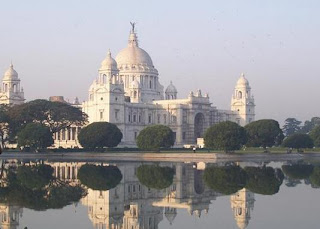
Queen Victoria Memorial, Kolkata


Thursday, 27 October 2011

Ever heard of a lakh or crore?

Hunter's Beach - worth the 2km trek


Z Hotel, Puri - once the home of the Raja of Serampore


Jagannath Temple in Puri - we were there for the Durja Puja festival


My first month's work has mainly involved researching the activities of Gram Vikas - familiarising myself with MANTRA (Movement and Action Network for Transformation in Rural Areas) and the various departments within the organisation (we employ over four hundred people in Orissa). I’ve also managed to get involved with hardware too; Indian website www.donateyourpc.in will shortly be supplying us with twenty PCs for schools run by Gram Vikas. The problem at the moment is that they need collecting from Hyderabad, only 880 kilometres away! Sounds like a job for one of our Mahindra Marshall jeeps (I won’t be driving). As we’re dealing with large numbers I’ll share with you the South Asian numbering system. You can skip the next few sentences if this is a bit nerdy but in addition to thousands and millions they also have lakhs (100,000) and crores (10,000,000). Numbers are written 3,00,00,000 instead of 30,000,000 – all very confusing. Their biggest number is known as “Adant Singhar” which is the equivalent of 10 with 41 zeros on the end. I guess such a large number is needed when you’re issuing Indian traffic violations! OK nerdy bit over. You may have noticed a new button (on the right of this page) which will now allow people to donate money to the Gram Vikas - we're using www.charitygiving.co.uk as our agent. In the next few weeks this button will also appear at www.gramvikas.org. Fellow volunteer (I was going to say VSO) Olive Fives will shortly be returning to Ireland and I'll be attempting to carry on some of her invaluable organisational development work. I’ll be process mapping (whatever that means – only joking Olive) the key functions of the organisation. Ultimately this may well lead to a return to The Gambia as project MANTRA will soon start providing help to African villages.

At the beginning of October (only a few weeks after my arrival) Hindus celebrated Durja Puja, one of the major festivals of the year. As the office was closed for the week I took the opportunity to visit Puri, a short (by Indian standards) five hour train trip to the north. Puri, as well as being a beach resort, is also home to one of the four main Hindu religious sites or “dhams”. The Jagannath Temple (interesting fact - this is where we get the word “juggernaut” from) is a very impressive 215 feet structure, during the festival only accessible by Hindus. The Rath Yatra celebrations in July include large towers that move along the streets with an "irresistible, destructive force" (a bit like the water buffalo on the small country lanes surrounding our campus!) I managed to get a room at the Z (pronounced Jed) hotel, an impressive mansion, once the home of Raja of Serampore). I paid a few rupees extra for AC, well worth it as this place has the coolest air-conditioning in India.

The following day we decided to head to the remote “Rangers” beach - so remote that we only knew it was just off the road to Konark (another impressive temple). We managed to get a willing auto-rickshaw driver (who charged two hundred rupees despite not knowing where he was going) and headed off. When we spotted Rangers' Restaurant we knew we weren't far; the remainder of the trip had to be done on foot. We trekked the final two kilometres making sure we kept a look-out for the white faded markings on the pine trees and the large wolf spider burrows in the ground. The hike was well worth it - as we approached we could hear the roar of the crashing waves from the Indian Ocean. We found a completely deserted beach, with a small beach hut made from palm leaves for shade.

As a requirement for my employment visa I had to register with my local police station within fourteen days of arrival. Other volunteers had warned me that this would involve numerous lengthy visits and multiple copies of paperwork (five of everything plus photos!). I only finished this process yesterday (I reckon on the sixth trip) and now have a full residents permit. On the plus side the office we sat in has a TV permanently set to Star Movies, which this time was showing The Chronicles of Narnia, the Lion, Witch and the Wardrobe (usually they show Bollywood stuff). We managed to watch most of it during our visit – I was there to only sign one document.

Having come to terms with the lack of "Indian" tonic water in Orissa I was in for another shock when I drank my first glass of Indian beer. It has a strange sweet after-taste that's the result of the addition of glycerine, which acts as a preservative. Even when you buy a recognized brand such as Carlsberg or Fosters you can't get away from it. We'll be heading to Calcutta soon to watch England in the cricket - I'm seriously hoping that I can get some unadulterated imported beer. I think there's more chance of England winning to be honest (maybe not, 5-0 in the ODI)! The only other option is to try and remove the glycerine. The technique is very risky and involves opening an upside down bottle under water (without shaking). As the glycerine is heavier than water (and alcohol is lighter than water) a yellow dollop of the offending preservative should slide out the upturned bottle. I'll let you know if I end up with any beer!

I hadn't been back to Bhubaneswar since my arrival in India. As it's the capital city of Orissa (with a population of 1.5 million) I seized the opportunity when invited to a party for NGO volunteers/workers to watch the rugby world cup final. It's only a four hour trip up the railway line, so a local trip really. Another part of Indian culture I hadn't experienced yet were the gangs of transvestites who harass travellers on trains for money. They are usually invited to weddings as a symbol of good luck and fertility – I guess they make extra money when they travel? Fellow volunteer Jack had a close shave when he tried to "stare-out” a gang member – problem was I think he smirked at one point (not recommended). I kept my head down and concentrated intensely on my book (sorry Jack).

We returned to Mohuda the following day - this time getting a local “express” train that stopped at every station – averaging a not particularly rapid 20 miles an hour. The train was absolutely packed (with no transvestites in sight to our relief). I ended up sitting on top of a luggage rack - I made the cardinal sin of leaving my sandals on as I climbed up. The guy below me went ballistic. After apologising profusely I was eventually invited back down (as the train became less crowded) and told to put my sandals back on! Uncertain if this was another custom I obliged.

As today is Diwali (Hindu festival of light) the office is closed again (a bit like The Gambia) - a good chance to catch up with the blog. We're heading into Berhampur later for a meal and to watch the fireworks - hopefully we’ll avoid getting blown up by firecrackers - fingers crossed. The jeep driver says we should avoid returning before nine as this is when the most of the carnage occurs!

Monday, 3 October 2011

Trains, Planes & Auto-Rickshaws

My new house, number 11 - it's got 24hr running hot water!


After a very long day I've finally arrived in Mohuda in south-east Orissa, India. I left home at 2.15pm in a taxi on 21st September and arrived at Gram Vikas in a Marshall jeep at 3am on the 23rd. Where did September 22nd go? I was greeted at Bhubaneswar airport by a driver from Gram Vikas, a friendly chap called Swaine - he would accompany me for the three hour train journey down the coast to Berhampur. My lift to the train station was made in a Hindustan Ambassador - fifty years ago this car was known as a Morris Oxford in the UK. It was the perfect car for my first trip in India. Using Indian Railways would also be fun - the 160km journey cost the princely sum of 77p - our tickets were for general class (these are the jam-packed cattle cars without reservations at the end of the train). Fortunately we found an empty sleeper car, although being very tired I didn't sleep a wink for fear of waking up 1,000km down the line in Chennai (formerly Madras). Most India towns are known by two names - the former colonial title and the original name that the country is now reverting to. It gets very confusing as the state of Orissa is officially Odisha and Berhampur is actually Bramhapur - various spellings exist and train stations use abbreviations - so the station I needed to look out for was BAM (not BRA or BER as you might expect). The number of people sleeping rough at the entrance to Berhampur station straight away shocked me - as we drove out of town (population of over 800,000 by the way) into the countryside people were sleeping at the side of the road, in rickshaws – basically wherever they could. The vegetation is very jungle like - a lot greener than The Gambia. The Gram Vikas estate is about a thirty minutes drive, I wasn't expecting it to be a walled village with a main gate set in one hundred and fifteen acres of jungle. After another five minute ride down a headlamp lit jungle track I finally viewed my new house - it was 3am - welcome to room three, near the bio-diesel labs.

The room was very small - it did have a bathroom with a toilet and shower, so things were definitely looking up! The days of checking my pit-latrine for bats were well and truly over. The other volunteers (Olive (VSO) from Ireland, Rich from Cheshire (near Chester not Sandbach), Jack from Wales, Matt from the US & Dorothy (from Bangalore) were based in much bigger rooms with facilities I could only dream of in The Gambia - kitchens, hot water, having access to more than one power socket. Nikolas, a German volunteer would shortly be leaving so I seized the opportunity - after all I needed a kitchen - I live to cook! Talking about food, Olive "kindly" woke me at 8.20am the following day to suggest we have breakfast at the mess! Three hearty meals are served each day, 8.30am breakfast, 1pm lunch & 8.30pm dinner. Looks like my butternut squash curry signature dish would have to be put on hold. We all wash our metal trays before and after eating – currently I’m the only one using a spoon. After a couple of days near the Bio-diesel plant I moved into my new home - it was a good job as two days later they found a five foot hooded-cobra there! I really like my new home - it has a nice tall ceiling, it's well ventilated so it keeps relatively cool. The wet-room/bathroom area is open to a screened mesh wall so the jungle outside can be very easily seen (and more importantly its occupants can't get in). There are only a few minor issues - my ceiling fan is permanently set to take-off speed and I have to hold the cistern when I flush for fear of ripping it off the wall! Mustn't grumble - all things considered it's five-star volunteer accommodation.

Gram Vikas stands for village development in Hindi - their main focus is the supply of water and sanitation systems for poor rural communities. In many rural villages the only supply of water is from the local stream or pond. This source may be quite a distance from the village and it falls on the women's shoulders (literally) to collect & carry the water each day. The same water source is also used for cleaning and human waste disposal. When I arrived at Gram Vikas I was warned that I would see a lot of people "ODing" when we went back into Berhampur. Is there really a big drug problem here? It turned out that "ODing" means open defecating - people will defecate by the side of the road, stream or pond. Obviously this presents a huge health risk. I didn't appreciate the less obvious impact it has on the community. Women don't want to bath in public so wait until night - and even then will wash fully clothed. Risk of attacks deters them even further. They will only make toilet trips at dusk or dawn and run the risk of related infections from "holding it in". Project Mantra (Movement and Action Network for the Transformation of Rural Areas) aims to supply a separate clean water supply, kitchen & bathroom for each family in a village. One hundred percent participation is required (one family that doesn't join can still pollute the whole village) and levels of financial commitment varies depending upon the wealth of the family. Once a clean water supply is installed village life dramatically improves. Human waste (after composting) can be used to grow crops; ponds that were previously polluted can be used to stock fish.

Life in the Mohuda settlement is very relaxed compared to our local town; we can arrange transportation into Berhampur if required. It's quite easy to remain in our peaceful oasis if you can get by without toilet paper (this will be covered in a later blog entry). The main forested area of the village is made up of Eucalyptus trees – we get the benefit of the wonderful fragrance on the way to work and their natural mosquito repellent properties too. For my first trip we headed into town with the imaginative plan of "having an Indian". We were saying goodbye to Nikolas (and thanks for the room) and enjoyed an amazing meal of tandoori chicken with butter nans, paneer, and kofta. My previous visit was at 3am so the sheer volume of people came as quite a surprise - 800,000 people, that's about half the entire Gambian population. The chaos on the roads was staggering - people on scooters/bikes (no helmets), cows, cars, buses, trucks, sheep, and dogs - all heading in whichever direction (and side of the road) they pleased. When we arrived at a roundabout I thought surely they'll all go round in the same direction. No chance - it was a complete free-for-all, to be fair you can't expect a cow or goat to understand the Highway Code. Despite the madness I didn't see a single crash - it somehow works; quite a few close shaves though. As we only have a one-day weekend (yes I work until 4pm on Saturday) - we decided to head to the nearest coastal town - Gopalpur-on-Sea (a very quaint name - it even had a lighthouse). We travelled by stretched auto-rickshaw (known as Tuk-tuks in Thailand) – “stretched” as in it could fit five people. This time I witnessed two crashes (one guy fell asleep on his scooter and hit the side of our rickshaw, the other guy left the road and landed in a padi field. Both appeared to be OK, if a bit startled. Gopalpur was once a fashionable location for the British (hence the name) it now feels a little run down - but the friendly staff at Grishnas Restaurant more than made up for it. We even managed to get a chocolate Cornetto for 30p.

Sunday, 18 September 2011

Time for a Change

After an amazing year in The Gambia I've decided to find a new challenge by volunteering in India. When I asked GramVikas.org (based in Orissa, East India) if they were looking for an IT expert I was surprised when they said "Yes, but in meantime you'll do". After a summer break back in the UK I head out to Berhampur (350 miles south of Kolkata/Calcutta) this week. Another adventure begins...